Automotive · external aerodynamics
WindsorML
355 Windsor-body variants with wall-modelled LES outputs and deterministic benchmark splits.
- Domain
- Automotive
- Cases
- 355 geometries
- Method
- WMLES
- Grid resolution
- About 300 million cells per case
- Stored size
- About 8 TB
- Licence
- CC BY-SA 4.0
01 · Overview
Dataset description
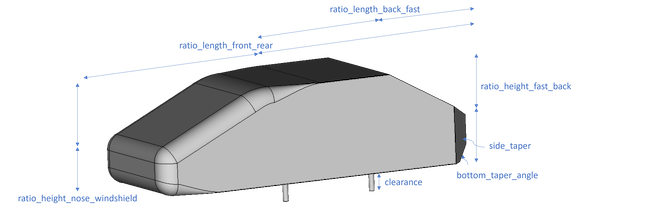
WindsorML comprises 355 geometric variants of the Windsor body, each evaluated using a GPU-native, wall-modelled large-eddy simulation. Its geometric complexity lies between the simplified Ahmed body and a complete road-car configuration.
The simulations use a Cartesian immersed-boundary approach with approximately 300 million cells per case. The repository provides geometry, three-dimensional surface and volume fields, force and moment coefficients and rendered views in standard scientific data formats. Native-point dual-area arrays accompany all 350 currently available boundary VTUs for physically area-weighted surface metrics.
Official deterministic train, validation and test splits are provided for a random baseline, nested data-efficiency studies, geometry extrapolation, drag-regime extrapolation and image-derived wake evaluation.
Potential research applications
Surrogate modelling of automotive aerodynamic quantities.
Comparison of learning behaviour across levels of geometric and flow complexity.
Prediction of surface fields, volume fields or integrated force targets.
Analysis of separated road-vehicle-like wakes across a consistent simulation set.
Area-weighted evaluation of predictions on the native boundary points.
02 · Contents
Available data products
| Data group | Description | Formats |
|---|---|---|
| Geometry | Parametric definitions plus tessellated and CAD surfaces | CSV · STL · STEP |
| Surface fields | Time-averaged boundary flow quantities | VTU |
| Surface quadrature | Barycentric dual-area weights aligned with native boundary points | NPY |
| Volume fields | Three-dimensional time-averaged solution fields | VTU |
| Integrated data | Drag, side force, lift and pitching moment coefficients | CSV |
| Derived views | Geometry and flow-field images across multiple planes | PNG |
| Official benchmark splits | Deterministic case lists, split-construction metrics, scripts and methodology | JSON · CSV · Python · PDF |
Native-point surface dual areas
Each sidecar contains one little-endian float32 barycentric dual-area weight in square metres per native boundary point, in the exact point order of the corresponding raw VTU.
| Property | Value |
|---|---|
| File pattern | run_N/boundary_dual_area_N.npy |
| Association | PointData · native points |
| Coverage | 350/350 available boundary cases |
| Units | m² |
| Sidecar payload | 3.17 GB |
03 · Official splits
Train, validation and test partitions
Eight deterministic split regimes are provided for standard benchmarking, data-efficiency studies and out-of-distribution evaluation. The committed JSON manifest is the source of truth for case membership.
Regimes and partition sizes
| Regime | Evaluation | Train | Validation | Test | Purpose |
|---|---|---|---|---|---|
full | In-distribution | 284 | 35 | 36 | Seed-42 random baseline, approximately 80/10/10 |
medium | In-distribution | 95 | 35 | 36 | Data efficiency: one third of the full training set |
scarce | In-distribution | 47 | 35 | 36 | Data efficiency: one sixth of the full training set |
super_scarce | In-distribution | 8 | 35 | 36 | Extreme data-efficiency evaluation |
geometry | Out-of-distribution | 248 | 36 | 71 | STL-surface Chamfer geometry extrapolation |
high_drag | Out-of-distribution | 248 | 36 | 71 | High-drag coefficient extrapolation |
low_drag | Out-of-distribution | 248 | 36 | 71 | Low-drag coefficient extrapolation |
image_wake | Out-of-distribution | 248 | 36 | 71 | Image-derived low-speed wake extrapolation |
Using the manifest
Download the JSON manifest and select the keys for the required regime. No split regeneration is required for standard benchmark use.
import json
from pathlib import Path

manifest = json.loads(Path("manifest.json").read_text())
train_ids = manifest["full_train"]
val_ids = manifest["full_val"]
test_ids = manifest["full_test"]
Manifest SHA-256 checksum
manifest.json 717957442d7deb0e3d5ad9e0078fa8b419c63732aca60937b69601d07abdb83604 · Data access
Repository access and file selection
The repositories are hosted on Hugging Face. The client can select individual data groups and estimate the transfer before files are retrieved.
pip install -U huggingface_hub hf_xet
hf auth login
File selection
Select data groups
--dry-run enabled Estimate the complete repository
hf download neashton/windsorml \
  --type dataset \
  --local-dir ./windsorml_data \
  --dry-run
05 · Citation
Citation and persistent identifiers
Users of WindsorML should cite the corresponding publication and include the dataset DOI where one is available.
@inproceedings{ashton2024windsor,
  title={WindsorML: High-Fidelity Computational Fluid Dynamics Dataset for Automotive Aerodynamics},
  author={Ashton, Neil and Angel, Jordan and Ghate, Aditya and Kenway, Gaetan and Wong, Man Long and Kiris, Cetin and Walle, Astrid and Maddix, Danielle and Page, Gary},
  booktitle={Advances in Neural Information Processing Systems},
  volume={37},
  year={2024},
  url={https://proceedings.neurips.cc/paper_files/paper/2024/hash/42a59a5f35b1b3c3fd648397c88a7164-Abstract-Datasets_and_Benchmarks_Track.html}
}
06 · Provenance
Provenance, licence and limitations
Contributors
- CFD workflow: Jordan Angel, Aditya Ghate, Gaetan Kenway, Man Long Wong, Cetin Kiris and Neil Ashton
- Geometry parameterisation: Astrid Walle
- Windsor consultation: Gary Page
- Machine-learning dataset guidance: Danielle Maddix
Licence
WindsorML is available under CC BY-SA 4.0. Review the repository licence before redistribution or adaptation.
Dataset catalogue