Automotive · realistic road-car aerodynamics
DrivAerML
A 500-geometry DrivAer notchback design space with scale-resolving CFD, STEP CAD for all 484 public runs and deterministic benchmark splits.
- Domain
- Automotive
- Cases
- 500-geometry design space
- Method
- Scale-resolving CFD
- Grid resolution
- Industrial-scale unstructured meshes
- Stored size
- About 31 TB
- Licence
- CC BY-SA 4.0
01 · Overview
Dataset description
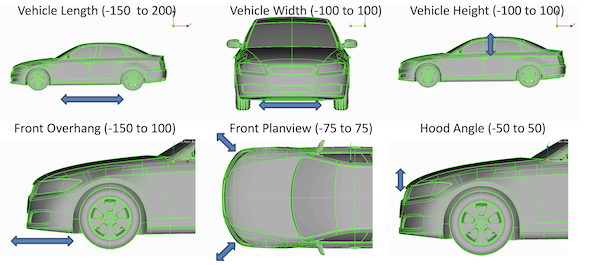
DrivAerML comprises a 500-geometry design space based on the DrivAer notchback vehicle. The cases were generated using an automated, scale-resolving CFD workflow representative of road-car aerodynamic analysis.
The repository contains geometry, reference parameters, surface and volume fields, aerodynamic coefficients, sampled slices, rendered views and OpenFOAM meshes. Mesh-native polygon-area arrays accompany every public boundary VTP for physically area-weighted surface metrics. The dataset permits evaluation of learning methods on geometry more complex than canonical bluff-body configurations.
STEP CAD geometry was added on 12 September 2026 for all 484 public runs. Each file uses millimetres and is stored as run_N/drivaer_N.step alongside the existing STL geometry and CFD data. View an example STEP file or select CAD geometry (STEP) in the download selector.
Official deterministic train, validation and test splits are provided for a public random baseline, nested data-efficiency studies, geometry extrapolation, drag-regime extrapolation and image-derived rear-separation evaluation.
Potential research applications
Surrogate modelling of road-car external aerodynamics.
Evaluation of geometric generalisation on complex vehicle surfaces.
Prediction of surface fields, volume fields or integrated coefficients.
Area-weighted evaluation of predictions on the native boundary polygons.
Extension of the dataset using the supplied meshes and documented workflow.
02 · Contents
Available data products
| Data group | Description | Formats |
|---|---|---|
| Geometry | Vehicle surfaces, geometry parameters and reference values | STL · CSV |
| CAD geometry | CAD definitions for all 484 public runs, with coordinates in millimetres | STEP |
| Surface fields | Time-averaged boundary quantities | VTP |
| Surface quadrature | Polygon areas aligned with the native boundary CellData order | NPY |
| Volume fields | Three-dimensional solution split into large-file parts on the Hub | VTU |
| Integrated data | Force and moment coefficients using variable and constant references | CSV |
| Reproduction assets | Slices, images and OpenFOAM meshes | VTP · PNG · OpenFOAM |
| Official benchmark splits | Deterministic case lists, split-construction metrics, scripts and methodology | JSON · CSV · Python · PDF |
Native boundary polygon areas
Each sidecar contains one little-endian float32 area in square metres per native boundary polygon, aligned with the polygon ID and CellData tuple order of the corresponding raw VTP.
| Property | Value |
|---|---|
| File pattern | run_N/boundary_cell_area_N.npy |
| Association | CellData · native polygons |
| Coverage | 484/484 public cases |
| Units | m² |
| Sidecar payload | 16.64 GB |
03 · Official splits
Train, validation and test partitions
Eight deterministic split regimes are provided for standard benchmarking, data-efficiency studies and out-of-distribution evaluation. The committed JSON manifest is the source of truth for case membership.
Regimes and partition sizes
| Regime | Evaluation | Train | Validation | Test | Purpose |
|---|---|---|---|---|---|
full | In-distribution | 400 | 34 | 50 | Seed-42 random public baseline |
medium | In-distribution | 133 | 34 | 50 | Data efficiency: one third of the full training set |
scarce | In-distribution | 67 | 34 | 50 | Data efficiency: one sixth of the full training set |
super_scarce | In-distribution | 11 | 34 | 50 | Extreme data-efficiency evaluation |
geometry | Out-of-distribution | 339 | 48 | 97 | STL-surface Chamfer geometry extrapolation |
high_drag | Out-of-distribution | 339 | 48 | 97 | High-drag coefficient extrapolation |
low_drag | Out-of-distribution | 339 | 48 | 97 | Low-drag coefficient extrapolation |
rear_separation | Out-of-distribution | 339 | 48 | 97 | Image-derived rear-separation extrapolation |
Using the manifest
Download the JSON manifest and select the keys for the required regime. No split regeneration is required for standard benchmark use.
import json
from pathlib import Path

manifest = json.loads(Path("manifest.json").read_text())
train_ids = manifest["full_train"]
val_ids = manifest["full_val"]
test_ids = manifest["full_test"]
Manifest SHA-256 checksum
manifest.json 032a2e9f88926d9218a1943b51e650135cc78683cad6b0a38f3cf4f9dfba647d04 · Data access
Repository access and file selection
The repositories are hosted on Hugging Face. The client can select individual data groups and estimate the transfer before files are retrieved.
pip install -U huggingface_hub hf_xet
hf auth login
File selection
Select data groups
--dry-run enabled Estimate the complete repository
hf download neashton/drivaerml \
  --type dataset \
  --local-dir ./drivaerml_data \
  --dry-run
05 · Citation
Citation and persistent identifiers
Users of DrivAerML should cite the corresponding publication and include the dataset DOI where one is available.
@article{ashton2024drivaer,
  title={DrivAerML: High-Fidelity Computational Fluid Dynamics Dataset for Road-Car External Aerodynamics},
  author={Ashton, Neil and Mockett, Charles and Fuchs, Marian and Fliessbach, Louis and Hetmann, Hendrik and Knacke, Thilo and Schonwald, Norbert and Skaperdas, Vangelis and Fotiadis, Grigoris and Walle, Astrid and Hupertz, Burkhard and Maddix, Danielle},
  journal={arXiv preprint arXiv:2408.11969},
  year={2024},
  url={https://arxiv.org/abs/2408.11969}
}
06 · Provenance
Provenance, licence and limitations
Contributors
- CFD workflow: Charles Mockett, Marian Fuchs, Louis Fliessbach, Hendrik Hetmann, Thilo Knacke and Norbert Schonwald
- Geometry and meshing: Vangelis Skaperdas, Grigoris Fotiadis and Astrid Walle
- DrivAer consultation: Burkhard Hupertz
- Dataset guidance and simulation: Danielle Maddix and Neil Ashton
Licence
DrivAerML is available under CC BY-SA 4.0. Review the repository licence before redistribution or adaptation.
Dataset catalogue