Aerospace · high-lift aerodynamics
HiLiftAeroML
1,800 WMLES cases spanning 180 NASA CRM-HL variants and ten angles of attack.
- Domain
- Aerospace
- Cases
- 1,800 cases
- Method
- Explicit WMLES
- Grid resolution
- 300–500 million cells per case
- Stored size
- About 66.9 TB stored
- Licence
- CC BY 4.0
01 · Overview
Dataset description
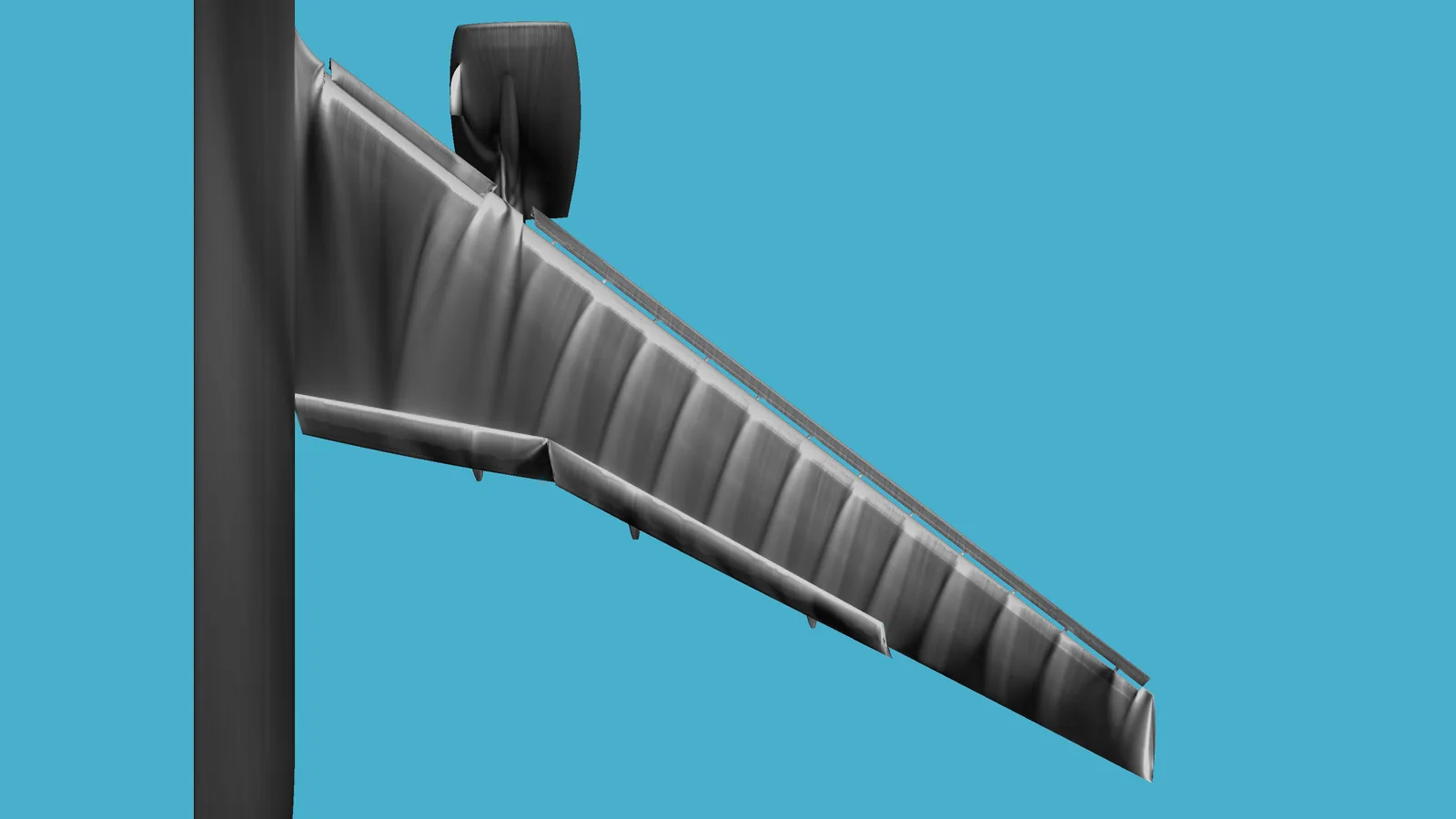
HiLiftAeroML comprises 1,800 simulations: 180 variants of the NASA Common Research Model in high-lift configuration, each evaluated at ten angles of attack from 4° to 22°. The dataset supports surrogate modelling of complex three-dimensional aircraft flows.
The simulations use GPU-accelerated explicit wall-modelled LES on solution-adapted grids containing 300–500 million cells. In addition to geometry, surface and volume fields and integrated coefficients, the repository provides deterministic training, validation and test splits and native-surface quadrature weights for reproducible, area-weighted evaluation.
Six force/moment records now use mean coefficients integrated from the released time-averaged surface fields, resolving discrepancies with the original solver-monitor means. The repository also publishes row-level metadata for invalid zero-filled entries in the native volume fields.
Potential research applications
Surrogate modelling of complete aircraft in high-lift configuration.
Evaluation of interpolation and out-of-distribution generalisation.
Assessment on unseen geometries, angles of attack, deflections and stall conditions.
Area-weighted evaluation of native-surface predictions.
02 · Contents
Available data products
| Data group | Description | Formats |
|---|---|---|
| Geometry | Tessellated and CAD definitions for each aircraft variant | STL · STEP |
| Surface fields | Compressed time-averaged boundary data | VTU.TGZ |
| Surface quadrature | Barycentric dual-area weights aligned with native boundary points | NPY |
| Volume fields | Compressed three-dimensional time-averaged solution | VTU.TGZ |
| Integrated data | Forces, moments, geometry values and flow reference values | CSV |
| Evaluation assets | Deterministic split families, manifests, validation records and plots | JSON · CSV · PNG |
| Data-quality metadata | Force/moment override provenance and native-volume zero-fill row IDs | JSON · JSONL · CSV |
Surface-integrated force/moment overrides
For six cases, the published mean force and moment coefficients were replaced with values obtained by canonical integration of the released time-averaged surface pressure and wall-shear fields. The remaining 1,794 cases retain their original solver-monitor means.
| Property | Value |
|---|---|
| Release | 2 September 2026 |
| Affected cases | geo_LHC012_AoA_16geo_LHC018_AoA_16geo_LHC028_AoA_18geo_LHC028_AoA_22geo_LHC129_AoA_4geo_LHC172_AoA_22 |
| Replaced mean columns | cd · cl · cm · clp · clv · cdp · cdv |
| Unchanged monitor columns | cd_stdev · cl_stdev · cm_stdev · cd_stderr · cl_stderr · cm_stderr · cd_ci95 · cl_ci95 · cm_ci95 |
Forces use exact degree-one integration on the ordered fan triangulation. Pitching moment uses exact degree-two integration about the per-case forcesCoR, with qRef, areaRef and chordRef taken from the corresponding reference CSV.
Files to refresh: If you downloaded the dataset before 2 September 2026, retrieve the six affected per-case force_mom CSV files again, together with the root force_mom_all.csv summary.
Native-point surface dual areas
Each sidecar contains one little-endian float32 barycentric dual-area weight in square inches per native boundary point, in the exact point order of the corresponding raw VTU.
| Property | Value |
|---|---|
| File pattern | geo_LHCi_AoA_j/boundary_dual_area_geo_LHCi_AoA_j.npy |
| Association | PointData · native points |
| Coverage | 1,800/1,800 cases |
| Units | in² |
| Sidecar payload | 1.02 TB |
Native-volume zero-fill rows
Across 419,416,158,837 native volume rows, 1,232,817 rows contain exact zeros in every exported flow and statistics field. The affected rows occur in 1,768 of the 1,800 cases and do not contain physically valid CFD solution states; omit them when using the released volume fields.
| Property | Value |
|---|---|
| Association | PointData · native volume rows |
| Affected cases | 1,768/1,800 cases |
| Rows to omit | 1,232,817/419,416,158,837 rows |
| Identification | Zero-based raw VTU row IDs selected by exact stored Float32 avg(P) == 0.0, then verified to be zero in every exported field. |
03 · Data access
Repository access and file selection
The repositories are hosted on Hugging Face. The client can select individual data groups and estimate the transfer before files are retrieved.
pip install -U huggingface_hub hf_xet
hf auth login
File selection
Select data groups
--dry-run enabled Estimate the complete repository
hf download nvidia/HiLiftAeroML \
  --type dataset \
  --local-dir ./hiliftaeroml_data \
  --dry-run
04 · Citation
Citation and persistent identifiers
Users of HiLiftAeroML should cite the corresponding publication and include the dataset DOI where one is available.
@article{ashton2026hiliftaeroml,
  title={HiLiftAeroML: High-Fidelity Computational Fluid Dynamics Dataset for High-Lift Aircraft Aerodynamics},
  author={Ashton, Neil and Clark, Adam and Heidt, Liam and Ivey, Christopher and Bose, Sanjeeb and Agrawal, Rahul and Goc, Konrad and Ranade, Rishi and Adams, Corey and Sharpe, Peter and Nidhan, Sheel and Akkurt, Semit and Leibovici, Daniel and Kossaifi, Jean},
  journal={arXiv preprint arXiv:2605.19565},
  year={2026},
  url={https://arxiv.org/abs/2605.19565}
}
05 · Provenance
Provenance, licence and limitations
Contributors
- Created by collaborators from NVIDIA, Cadence Design Systems and The Boeing Company
- Computing support from Cadence, NVIDIA, TACC, CSCS and Oak Ridge Leadership Computing Facility
Licence
HiLiftAeroML is available under CC BY 4.0. Review the repository licence before redistribution or adaptation.
Dataset catalogue